
Gurgaddi Divas of Sri Guru Granth Sahib Ji and the Seva of the Rumala Sahib
Each year the sangat (the congregation) remembers a day that shapes every Sikh home and every Gurdwara (Sikh place of worship): the day Sri Guru Granth Sahib Ji was enthroned as Guru. This year, Gurgaddi Divas (the day of the Guru’s enthronement) falls on 11 November 2026, as per the SGPC calendar, which gives it as 26 Katak (Katak being a month of the Sikh calendar) [1]. Some sangats follow other calendars, so it is worth confirming the date with your local Gurdwara.
This is a fitting time to reflect on what Sri Guru Granth Sahib Ji means to us, and on one small, loving act of care: the Rumala Sahib, the cloth that covers Sri Guru Granth Sahib Ji.

What Gurgaddi Divas commemorates
In 1708, at Nanded in present-day Maharashtra, Guru Gobind Singh Ji, the tenth Guru, ended the line of personal Guruship and conferred the Guruship on Sri Guru Granth Sahib Ji [2][3]. From that day, Sri Guru Granth Sahib Ji has been honoured as the eternal Guru [2][3].
SikhNet’s account of the day describes Guru Gobind Singh Ji telling the Khalsa (the community of initiated Sikhs) to look to Sri Guru Granth Sahib Ji as the visible body of the Guru, and to obey it [2]. This is why Sri Guru Granth Sahib Ji is approached with the reverence due to the Guru, and why we seek the Guru’s guidance through Gurbani (the Sikh holy scriptures [4]).
Gurgaddi Divas is therefore not only a historical anniversary. It is a reminder that the Guru is present with the sangat today, in every Gurdwara and in every home where Sri Guru Granth Sahib Ji is respectfully installed.
How the Sikh Rehat Maryada asks us to care for the Guru
The Sikh Rehat Maryada (the Sikh code of conduct published by the SGPC, the Shiromani Gurdwara Parbandhak Committee) gives clear guidance on how Sri Guru Granth Sahib Ji is to be cared for [4][7]. In summary, it says that:
- Sri Guru Granth Sahib Ji should be opened, read and closed with reverence [4].
- The place where Sri Guru Granth Sahib Ji is installed should be absolutely clean, with an awning above [4].
- Sri Guru Granth Sahib Ji should rest on a cot of suitable size, overlaid with clean mattress and sheets, with suitable cushions [4].
- Romalas, described as sheet covers of appropriate size, are used to cover Sri Guru Granth Sahib Ji, and when Sri Guru Granth Sahib Ji is not being read, it should remain covered with a romal [4].
- A whisk should also be present [4].
The Rumala Sahib, then, is not decoration. It is part of the respect the Sikh code of conduct asks us to show to our Guru: keeping Sri Guru Granth Sahib Ji covered with something clean and fitting when the Guru is not being read [4].
What a Rumala Sahib is
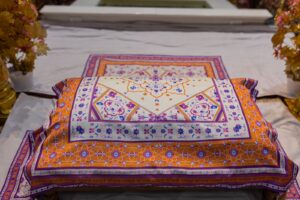
A Rumala Sahib (also written “romal” or “romala”) is a cover of appropriate size for Sri Guru Granth Sahib Ji [4]. Rumala Sahibs are made in many colours and designs, but the Sikh Rehat Maryada’s emphasis is on what is clean, fitting and offered with reverence [4], not on grandeur.
If you would like to read more about the spirit of Rumala seva (selfless service in the making and offering of Rumala Sahibs), our earlier post, Rumala Sewa: Weaving Sikh Faith, reflects on it in more depth.
Offering a Rumala Sahib as seva
Seva holds a special place in Sikh life: the Sikh Rehat Maryada describes voluntary service as a prominent part of the Sikh religion [6]. Offering a Rumala Sahib is one way a family can take part in that seva.
The Sikh Rehat Maryada also speaks of offerings at the conclusion of a complete reading of Sri Guru Granth Sahib Ji, known as a Path [4]. It says that, on the conclusion of the reading, draperies, a fly whisk and an awning, having regard to the requirements of Sri Guru Granth Sahib Ji, should be offered according to one’s means [4].
On Gurgaddi Divas, some families may wish to offer a new Rumala Sahib in gratitude. A few gentle thoughts, if you are considering it:
- Ask first. If you plan to offer a Rumala Sahib at a Gurdwara, speak with the Gurdwara’s sevadars (those who serve there) beforehand. They can tell you what sizes and colours suit their needs and how they receive offerings.
- Think of the requirement, not the display. The Sikh Rehat Maryada’s words, “having regard to the requirements of” Sri Guru Granth Sahib Ji [4], are a good guide. A clean, well-fitting Rumala Sahib offered with love is complete seva.
- Offer to the best of your means. The same passage asks that offerings be made “to the best of means” [4]. There is no expectation of grandeur.
- Keep it clean. Store a Rumala Sahib folded and clean, apart from everyday cloth, so that it is ready to be used with respect.
Our own small part in this seva
Divinity Rumala began in 2022, out of a passion for seva, a connection to Waheguru (the name of God, which the Sikh Rehat Maryada renders as “Wondrous Destroyer of darkness” [5]), and a knowledge of clothing and premium fabrics. Our founder began alone; today a team of three to four artisans works in our workshop in Delhi.
Every Rumala Sahib is tailored with full respect for the sanctity of our sovereign and eternal Guru, Sri Guru Granth Sahib Ji. The borders, motifs and patterns in our designs are inspired by the art found throughout Sri Darbar Sahib (Sri Harmandir Sahib, the Golden Temple, Amritsar).
For families who feel moved to offer a Rumala Sahib, the Rumala Sahib sets for Sri Guru Granth Sahib Ji page describes the sets, and our Rumala Seva page shows the collection.
Remembering the Guru on Gurgaddi Divas
Whether or not you offer anything this year, Gurgaddi Divas is a day to come before the Guru with gratitude. It can be a day to join the sangat at the Gurdwara for Kirtan (devotional singing of Gurbani [4]). At home, it can be as simple as sitting together, reading or listening to Gurbani, and remembering that the Guru’s word is with us always.
May Waheguru bless every family that bows before Sri Guru Granth Sahib Ji this Gurgaddi Divas.
Sources
- SikhNet, Sikh Gurpurab Calendar 2026–27 (dates as per SGPC calendar): https://sikhnet.com/pages/sikh-gurpurab-calendar
- SikhNet, “Guru Gaddi Day” (commemorating Sri Guru Granth Sahib Ji): https://sikhnet.com/node/98090
- Takht Sachkhand Sri Hazur Sahib, Nanded: History (HazurSahib.com): https://hazursahib.com/web/history
- Sikh Rehat Maryada (SGPC), Section Three, Chapters IV to IX (English text): https://www.sikhs.org/reht3.htm
- Sikh Rehat Maryada (SGPC), Section Two, Chapter III (English text): https://www.sikhs.org/reht2.htm
- Sikh Rehat Maryada (SGPC), Section Five, Chapter XII: Voluntary Service (English text): https://www.sikhs.org/reht5.htm
- Sikh Rehat Maryada, official English edition (SGPC, PDF): https://sgpc.net/storage/2026/06/Sikh_Rehat_Maryada_English.pdf

About author



Add comment