
Prakash Purab of Guru Nanak Dev Ji: Preparing an Akhand Path at Home
Every year the sangat (the congregation) comes together with joy for the Prakash Purab (the anniversary of the birth) of Guru Nanak Dev Ji, the first of the ten Sikh Gurus. The date changes from year to year [2]. In 2026, for example, it fell on 24 November, as per the calendar of the SGPC (Shiromani Gurdwara Parbandhak Committee, the body that manages historic Gurdwaras), which gave it as 9 Maghar (Maghar being a month of the Sikh calendar) [1]. For the coming year, check the current SGPC calendar. It is also worth confirming the date with your local Gurdwara (Sikh place of worship).
For many families, a Gurpurab (a Guru’s anniversary) is a time to bring the Guru’s word into the home. One of the most heartfelt ways to do this is an Akhand Path: the continuous, uninterrupted reading of Sri Guru Granth Sahib Ji from beginning to end. This post reflects on the day, and gathers what the Sikh Rehat Maryada (the Sikh code of conduct published by the SGPC) says about preparing an Akhand Path, so that a family can prepare with care and calm.

Remembering Guru Nanak Dev Ji
Guru Nanak Dev Ji was born in 1469 at Rai Bhoi di Talwandi, the village now known as Nankana Sahib, in Punjab, Pakistan [2]. He is honoured as the founder of the Sikh faith and the first of the ten Sikh Gurus [2].
Guru Nanak Dev Ji travelled far and wide, sharing the message of Ik Onkar (ੴ, “One God”), the One who dwells in all of creation [2]. His teaching laid the foundation of a way of life rooted in equality, love, goodness and virtue [2]. He left this world in 1539 at Kartarpur [2].
The Prakash Purab is therefore a day of gratitude. It is a day to remember that the light Guru Nanak Dev Ji brought into the world is with the sangat still, through Gurbani (the Guru’s word), enshrined in Sri Guru Granth Sahib Ji.
Joining the sangat at the Gurdwara
Many families begin the day at the Gurdwara. The Sikh Rehat Maryada describes how the congregational service in the Gurdwara generally begins: with the ceremonial opening of Sri Guru Granth Sahib Ji, Kirtan (devotional singing of Gurbani), exposition of the scriptures and discourses [3]. On a Gurpurab, sitting with the sangat and listening to Kirtan is a beautiful way to remember the Guru.
At home, the day can be marked just as sincerely. Some families read or listen to Gurbani together. Others hold an Akhand Path so that the reading concludes around the Gurpurab.
What the Sikh Rehat Maryada says about an Akhand Path
The Sikh Rehat Maryada describes the Akhand Path as the non-stop reading of Sri Guru Granth Sahib Ji, carried on “at hard times or on occasions of elation or joy” [3]. It takes about forty-eight hours, and “the non-stop reading implies continuous uninterrupted reading” [3].
A few points from the Sikh Rehat Maryada are especially helpful for a family preparing one at home [3]:
- The family takes part itself. “Whichever family or congregation undertakes the non-stop reading should carry it out itself through its members, relatives, friends, etc., all together. The number of reciters is not prescribed.” [3]
- The reader is never left alone. The Sikh Rehat Maryada says it should never happen that the reader carries on the reading alone, with no member of the family or congregation listening [3]. Planning who will sit with the reading, hour by hour, is a loving form of seva (selfless service).
- Care for those who read. “The reader should be served with food and clothing to the best of the host’s means.” [3]
- Nothing ritual is added. Placing a pitcher, a ceremonial lamp, a coconut and similar items around Sri Guru Granth Sahib Ji during the reading is described as “contrary to the gurmat (Guru’s way)” [3].
Beginning and concluding the reading
The Sikh Rehat Maryada gives a simple order for beginning. The Karah Prashad (the sacred pudding) is first laid. Then, after the recitation of six stanzas of Anand Sahib (a hymn of Gurbani), the Ardas (the Sikh prayer) is offered and the Hukam (the Guru’s command, read from Sri Guru Granth Sahib Ji) is taken, and the reading begins [3]. Karah Prashad is made from equal quantities of wheat flour, pure sugar and clarified butter, while reciting the scriptures [3].
At the conclusion, after Anand Sahib is recited, the Ardas for the conclusion of the reading is offered and the Karah Prashad is distributed [3].
Because the reading takes about forty-eight hours [3], families who wish it to conclude on the Gurpurab itself plan the start accordingly. Your local Gurdwara or a Granthi (the person who reads Sri Guru Granth Sahib Ji and cares for the Gurdwara) can help you plan the timing and the readers.
Preparing the place for Sri Guru Granth Sahib Ji
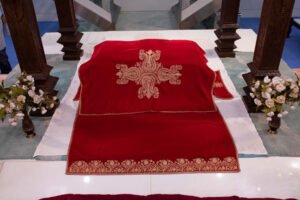
Before the Path begins, the place where Sri Guru Granth Sahib Ji will be respectfully installed is prepared with care: clean, quiet and fitting. The Sikh Rehat Maryada says romalas, described as “sheet covers of appropriate size”, are used for covering Sri Guru Granth Sahib Ji, and that when Sri Guru Granth Sahib Ji is not being read, it should remain covered with a romal [3]. A Rumala Sahib (also written “romal” or “romala”) is that cover.
The Sikh Rehat Maryada also speaks of offerings at the conclusion of the reading. It says that, on the conclusion of the reading, offerings of draperies, a fly whisk and an awning, as Sri Guru Granth Sahib Ji requires, should be made “to the best of means” [3]. The words “to the best of means” are a gentle reminder: what matters is a clean, fitting offering made with love, not grandeur.

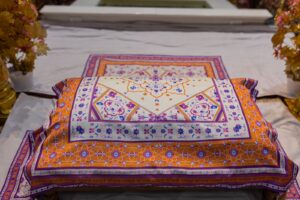
If your family is preparing a Rumala Sahib for the Path, our page on the Rumala Sahib set for Sri Guru Granth Sahib Ji explains the kinds of sets we make. The Basant Rumala Sahib shown above is one of our printed designs. For more on why the Rumala Sahib covers Sri Guru Granth Sahib Ji, you may also like our reflection on Gurgaddi Divas and the seva of the Rumala Sahib.
Our own small part in this seva
Divinity Rumala began in 2022, out of a passion for seva, a connection to Waheguru (the name of God, which the Sikh Rehat Maryada renders as “Wondrous Destroyer of darkness” [4]), and a knowledge of clothing and premium fabrics. Our founder began alone; today a team of three to four artisans works in our workshop in Delhi. Every Rumala Sahib is tailored with full respect for the sanctity of our sovereign and eternal Guru, Sri Guru Granth Sahib Ji.
A day of light
Whether your family holds an Akhand Path, joins the sangat at the Gurdwara, or simply sits together with Gurbani at home, the Prakash Purab of Guru Nanak Dev Ji is a day to come before the Guru with gratitude. May the light of the Guru’s word fill every home on every Gurpurab.
Sources

About author



Add comment